 RemoteShift
Your English Is Worth Money Online: 5 Ways to Get Paid
If you speak and write clear English, you can earn real money online — without a degree, without a teaching certificate, and without being a native speaker. Online tutoring, content writing, transcription, virtual assistant work, and English-speaking customer service are all paths that pay in USD and that your language skills can open right now.
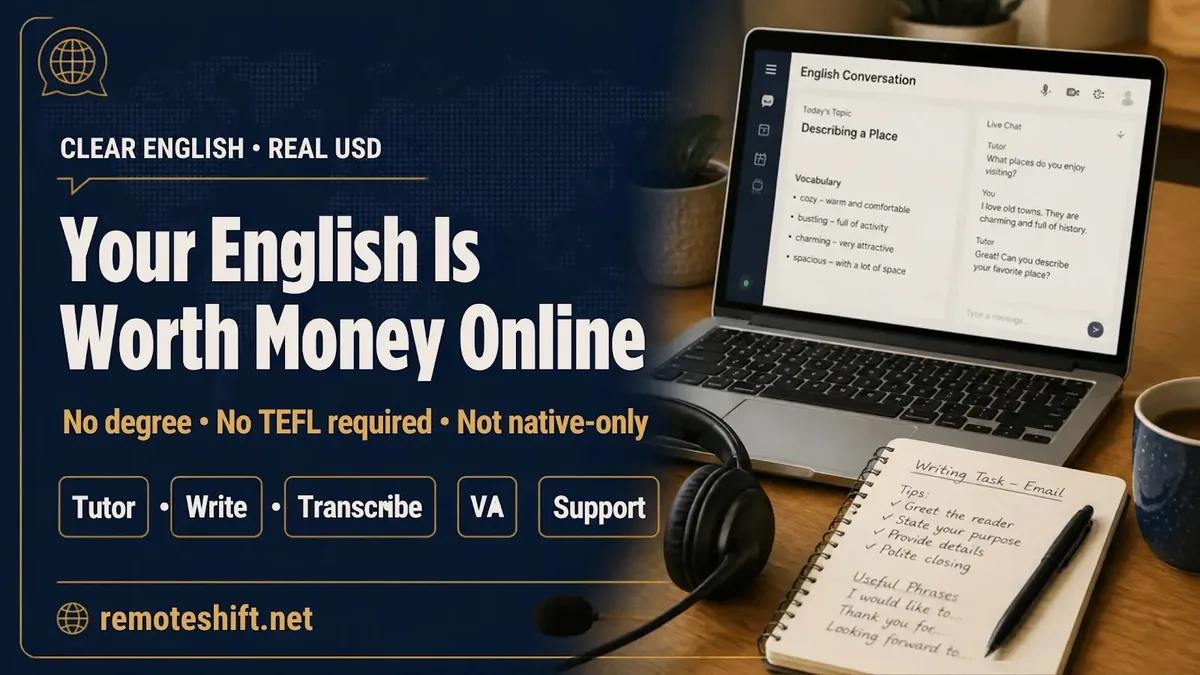
Here's something that surprises a lot of people. The thing you do without even thinking about it — speaking and writing in clear, understandable English — is something millions of people and companies around the world pay for constantly. And most of the people who could be earning from it assume they're not qualified enough to start.
That assumption is costing them real income. Let's go through the actual paths.
Path 1: Online English tutoring (no teaching degree required)
Online tutoring is the most obvious one, and for good reason — the demand for English conversation practice is enormous and genuinely global. Students in South Korea, Brazil, the Middle East, and dozens of other markets pay hourly for one-on-one conversation time with a confident English speaker.

What you actually need: clear English, patience, and the ability to make a nervous learner feel comfortable. That's it. You're not delivering lectures. For conversational practice, the job is structured conversation — and you get paid per hour for having it.
Three platforms that don't require formal qualifications:
- Preply — one of the biggest tutoring platforms; set your own rate, build a profile, students book you directly
- italki — similar model; separates "professional teachers" from "community tutors" (no cert needed for the second)
- Cambly — the simplest option; almost entirely casual spoken conversation, very little formal teaching involved
Starting rate reality: your first weeks will have an empty calendar. This is normal. Start at a lower rate, deliver good lessons, collect your first reviews, then raise your rate. The reviews are what move the needle — getting them is the actual work of month one.
If you speak English plus another language: that's a genuine advantage, not a weakness. Many students specifically want a tutor who understands their first language. Your bilingualism is a selling point.
Path 2: English content writing and copywriting
Companies need content constantly — blog posts, product descriptions, email copy, website text, social media captions. A large portion of that demand comes from US and UK companies willing to pay remote writers who produce clear, readable English.
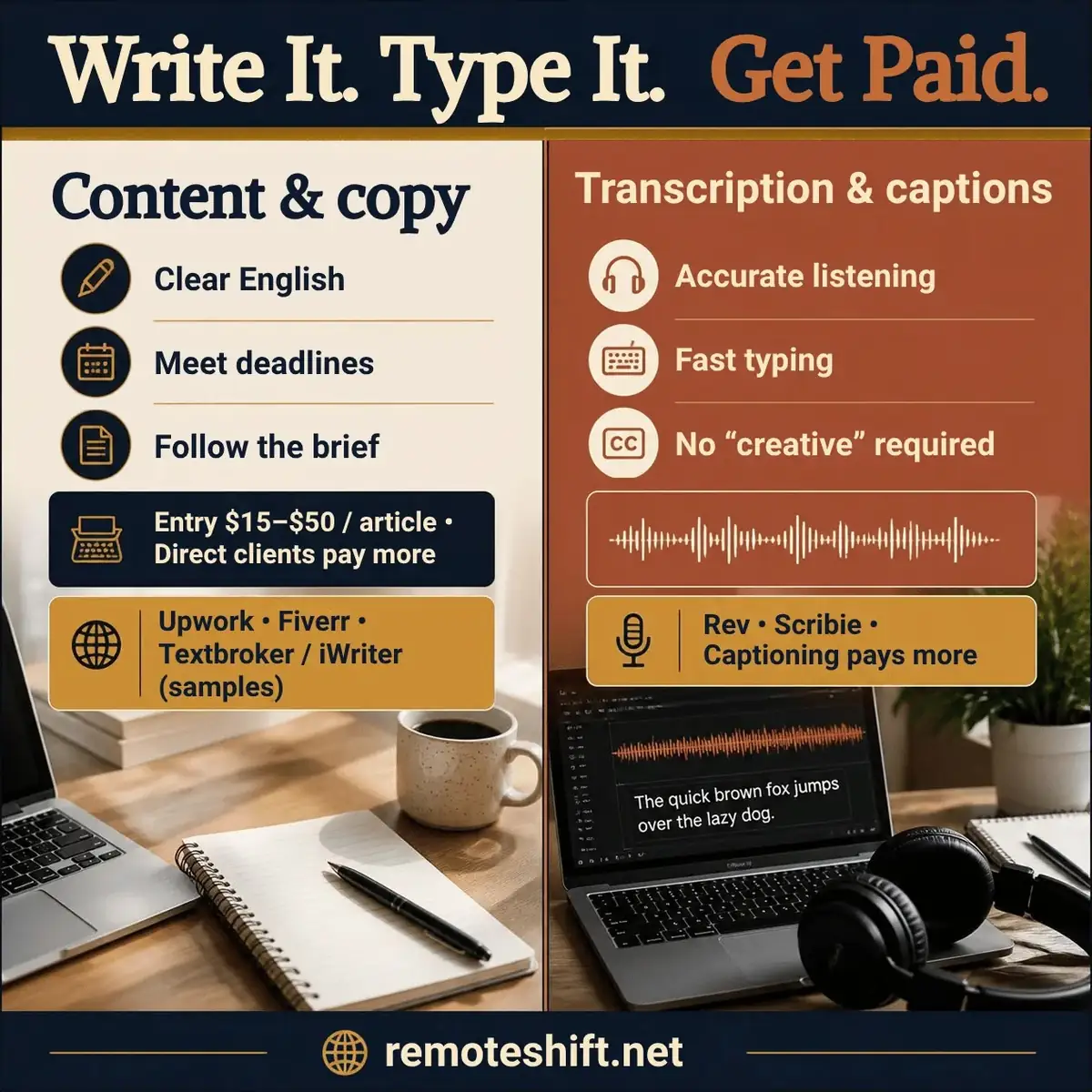
You don't need to be a perfect writer to start. You need to write clearly, meet deadlines, and follow a brief. Most entry-level content writing pays $15–$50 per article; experienced writers working with direct clients earn considerably more.
Where to start: Upwork and Fiverr let you create a profile and bid on writing jobs. Content mills like Textbroker and iWriter pay less but are accessible with zero history — useful for building early samples before pitching higher-paying clients.
Path 3: Transcription and captioning
Transcription is turning spoken audio or video into written text. It pays less per word than content writing, but it's one of the most accessible starting points because it doesn't require creative output — just accurate listening and typing.
Platforms like Rev and Scribie hire transcriptionists remotely, pay per audio minute, and don't require prior experience. Captioning (adding subtitles to video) is a related skill that pays better and is increasingly in demand as video content scales across every industry.
Path 4: Virtual assistant roles for English-speaking companies
US and UK businesses hire virtual assistants constantly for email management, scheduling, research, data entry, and customer communication. The one non-negotiable requirement is strong written English — because you're communicating on behalf of the business.

Starting rates typically run $12–$20/hour; VAs who specialize or build long-term client relationships earn significantly more. For a full breakdown on getting started, read our guide to becoming a virtual assistant from outside the US.
Path 5: Customer service and support for US companies
Remote customer service roles are among the highest-volume job categories for non-US English speakers right now. Companies hire support agents, chat representatives, and email support specialists — and they pay in USD. The requirement is clear written and spoken English and the ability to stay calm and helpful under pressure.
If you have any background in call center work, this path converts your existing experience directly to remote income. The tools are different (Zendesk, Slack instead of a desk phone), but the core skill is identical. See our guide on remote customer service jobs and what they actually pay.
A note on the pay figures: the hourly ranges in this post are estimates, not guaranteed rates. What you earn depends on the company, the client and where you live, and rates for workers outside the US are often lower.
Which one is right for you?
Teaching is great if you're patient and enjoy one-on-one interaction. Writing suits people who prefer async work. Transcription is the lowest-friction starting point. VA and CS work suit people who like structure and variety in a support role.
The worst thing you can do is pick one based on what sounded good in a blog post, try it for three weeks, and decide it isn't working — when actually it just wasn't the right fit. I built a free 60-second quiz that does exactly that — take it at remoteshift.net and it'll tell you which path fits your actual background and preferences.
Once you start earning, Wise is a practical way to receive USD from outside the US — mid-market exchange rate and a transparent fee shown upfront.
Disclosure: some links in this post are affiliate links. If you sign up through them, RemoteShift may earn a commission at no extra cost to you.
Frequently asked questions
Can non-native English speakers teach English online?
Yes. Many tutoring platforms, including italki and Preply, welcome non-native speakers as community tutors. Clear, confident English is what matters — not your passport or birthplace.
How much can you earn teaching English online?
Community tutors on italki typically earn $8–$20/hour when starting. Experienced tutors with good reviews can charge $25–$50/hour or more. Preply tutors often earn more per session but the platform takes a larger commission.
Do you need a degree to make money with English online?
No. For tutoring, content writing, transcription, VA work, and customer service, there is no degree requirement. What matters is demonstrated ability — your writing samples, reviews, or portfolio.
What is the easiest way to start earning with English skills online?
Transcription is the lowest-barrier entry point — platforms like Rev don't require prior experience and you start earning per audio minute almost immediately. Cambly is similarly accessible for spoken English.
Can you earn in USD with English skills without leaving your country?
Yes, all five paths are remote and pay in USD. You work from wherever you are, get paid through Wise, Payoneer, or the platform's built-in payout system, and never need to relocate.