 RemoteShift
Coming Back to Work After Years Away? Try Remote First
If you've been out of the workforce for years — raising children, caring for family, dealing with illness or a life change — remote work is genuinely your best re-entry point. The years you spent running a home gave you real management skills: scheduling, budgeting, multi-tasking under pressure, keeping everything moving without anyone telling you what to do. Virtual assistant, customer support, and data entry are the three roles most likely to hire someone coming back, and they fit around the responsibilities you still have.
There's a particular fear that comes with deciding to go back to work after years away. If you've been in this spot, you probably know it well.
It sounds like this: "It's been so long. I've forgotten how to do this. There's a huge gap on my CV and everyone's going to ask about it. The world has moved on without me. Who's going to hire someone like me?"
Almost none of that holds up once you look at it honestly.
The "gap" on your CV isn't what you think it is
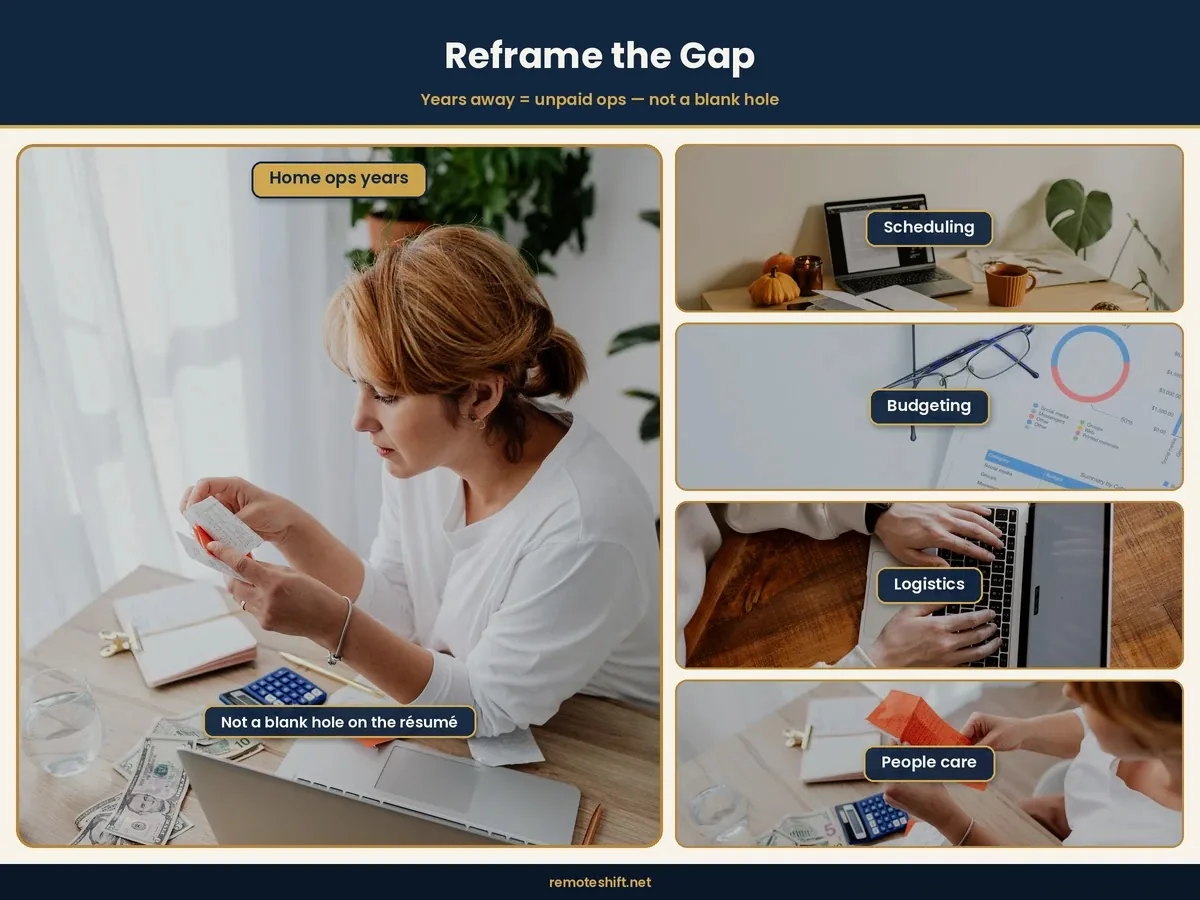
You think of those years as empty time — a hole in your work history. They weren't empty. If you ran a home, you ran operations. You managed a budget on tight money and made it stretch. You handled a schedule with more moving parts than most office calendars. You negotiated, mediated, planned, and kept everything running while half of it was on fire — with no time off and no manager telling you what to do next.
That's not a gap. That's unpaid management experience, and the skills are real even if nobody handed you a payslip for them.
When it comes to describing those years on a CV or in an application, the translation is simpler than you think: "managed household operations and family care responsibilities, including budget management, scheduling coordination, and multi-stakeholder logistics." It sounds different from "stayed home with kids." It's not a lie — it's an accurate description of what you actually did.
Why remote work specifically is your best re-entry door
Going back to a traditional office is hard for reasons that have nothing to do with whether you can do the job. Commute time, rigid hours, office politics, having to be visibly present from 9 to 5 — all of that creates pressure before you've even started the work itself.
Remote work quietly removes most of those barriers:
- No commute eating two hours of your day
- Flexibility around the people who still depend on you
- The ability to start part-time and build up instead of jumping to full days before you're ready
- Working from your own space, which removes the anxiety of being physically present in an unfamiliar environment
The arrangement bends around your life instead of demanding your life bend around it. For someone easing back in after years away, that changes everything.
The three remote roles most likely to hire you
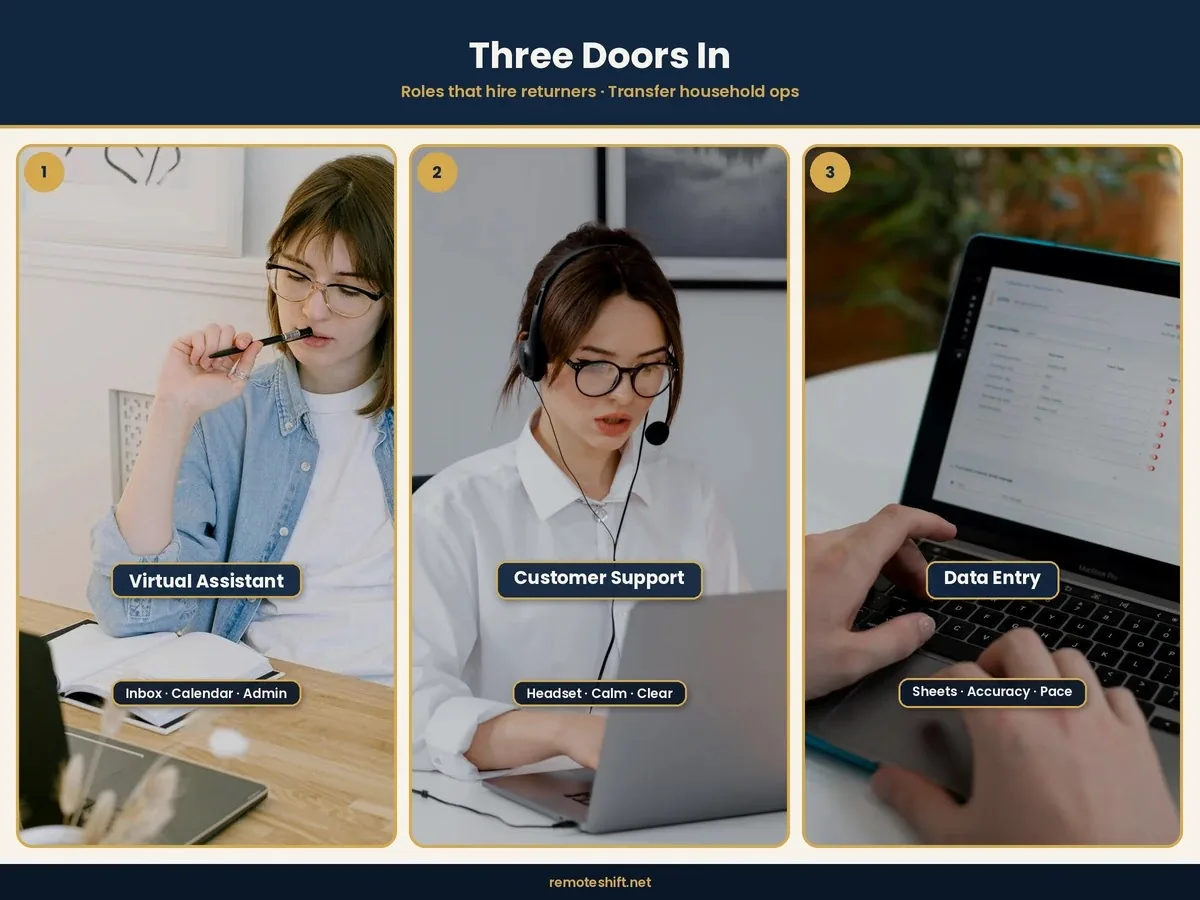
Virtual assistant is one of the most natural fits for someone coming back after time at home. Managing email, organizing calendars, handling bookings, keeping a busy person organized — you've been the unpaid version of this for your whole household. Small business owners and founders who need this kind of support aren't looking for someone with an impressive CV; they're looking for someone dependable who does what they say they'll do. That's you. Here's how to become a virtual assistant with no experience.
Remote customer support is the second strong path. If you're patient, if you can stay calm with a frustrated person and make them feel heard, companies want you. That patience you built during years of caring for others — children, aging parents, family — doesn't switch off. It transfers directly into helping customers, and it's harder to find in an employee than most hiring managers will admit.
Data entry and back-office admin is the gentlest re-entry of the three. Steady, low pressure, no requirement to be on camera or sell anything. You handle records, organize information, keep things accurate. For someone who wants to ease back in without performance pressure, this is a real, paid, legitimate starting point — and more abundant than you'd expect. Start with our guide to data entry jobs from home.
How to handle the "employment gap" question
This is the question everyone dreads. The honest answer works better than any clever spin.
"I took several years away from formal employment to care for my family. That time required managing a household budget, coordinating complex schedules, and staying calm under pressure — skills I'm now ready to apply in a professional remote context."
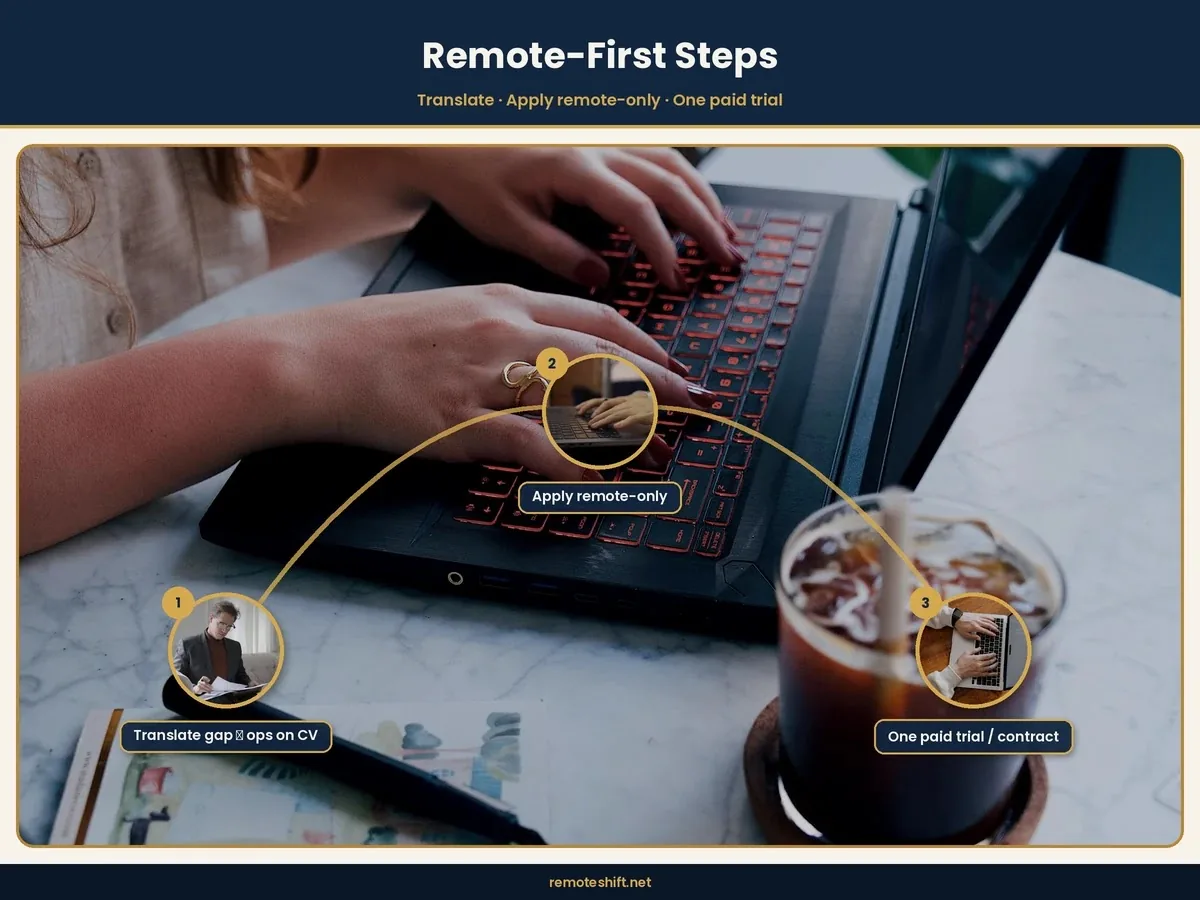
That's it. No apology, no over-explaining. Most remote employers, especially smaller companies and founders, respect that straightforwardness. They're far more worried about whether you'll show up and deliver than about what you did five years ago.
If you did anything during those years that has even a loose connection to professional work — tutoring, bookkeeping for a family business, running a community group, any freelance or volunteer work — mention it. It all counts.
The honest part nobody tells you
The first step back is going to feel uncomfortable. You'll second-guess yourself. The first time you apply, or the first time you have a video call with a potential client, your stomach may be in knots. That's normal, and it's not a sign you're not ready. It's the rust coming off. Everyone who's been out for a while feels it. The people who successfully make it back are not the ones who feel no fear — they're the ones who do the thing while the fear is still there.
The most common mistake people in this position make is waiting until they feel "ready" or "qualified enough." That day has a way of never quite arriving, because confidence doesn't come before you start. It comes from starting. You take one small step, it goes reasonably well, and suddenly the next step is less terrifying than the first.
You don't need to map out your whole new career tonight. You need to identify the one right starting point for your specific situation, and aim your energy there instead of scattering it across everything at once.
That's exactly what our free 60-second quiz was built to do. It asks you a few honest questions about how you naturally work and what your background looks like, and points you to the remote path that fits someone coming back after time away. Take it at remoteshift.net — it takes less than a minute and removes a lot of the guessing.
You didn't lose your skills during those years at home. You built different ones. Time to get paid for them.
When that first USD payment arrives, Wise is a practical way for international remote workers to receive it — real US account details and the mid-market exchange rate.
Also useful
Once you know your starting role, the full application process is in our guide on how to get a remote job from outside the US. And if you've already been applying and hearing nothing back, see why you're not getting remote jobs — the five specific fixes that change results. If age is part of the worry, read starting remote work in your 40s or 50s.
Disclosure: some links in this post are affiliate links. If you sign up through them, RemoteShift may earn a commission at no extra cost to you.
Frequently asked questions
Can I get a remote job after years out of the workforce?
Yes — remote work is one of the most accessible re-entry points for people who've been out of formal employment for several years. Virtual assistant, customer support, and data entry roles don't require recent work history; they require reliability and the ability to do the work. The skills you used running a home and managing family responsibilities translate directly to these roles.
How do I explain a gap in employment when applying for remote jobs?
Be direct and reframe it honestly: "I took several years to care for my family and manage household responsibilities." You can add specifics — budget management, scheduling, coordination — that frame the years as skills rather than absence. Most remote employers, especially small companies, respond well to straightforwardness. Apologizing or over-explaining tends to draw more attention to the gap than a confident, factual answer does.
What remote jobs are good for stay-at-home parents returning to work?
Virtual assistant, remote customer support, and data entry are the most accessible. They hire regularly, start part-time in many cases, and directly use skills developed during years at home. More experienced candidates can also look at scheduling coordination, intake admin, and social media management for small businesses.
How do I get remote work experience if I have none?
Start with one small gig — a part-time VA job, a trial customer support contract, a data entry project — and treat it as your entry point. Even one paid remote engagement gives you something concrete to reference in future applications. From there, each step becomes easier than the one before it. The first one is always the hardest.
Is it too late to start remote work in my 40s or 50s?
No. Remote employers are hiring for reliability, communication, and the ability to get the work done — none of which diminishes with age. Employers hiring for customer-facing and administrative roles value steadiness under pressure, which tends to come with life experience. Age is not the barrier it can be in a traditional office environment.