 RemoteShift
Start an AI Services Business (No Code, Under $100)
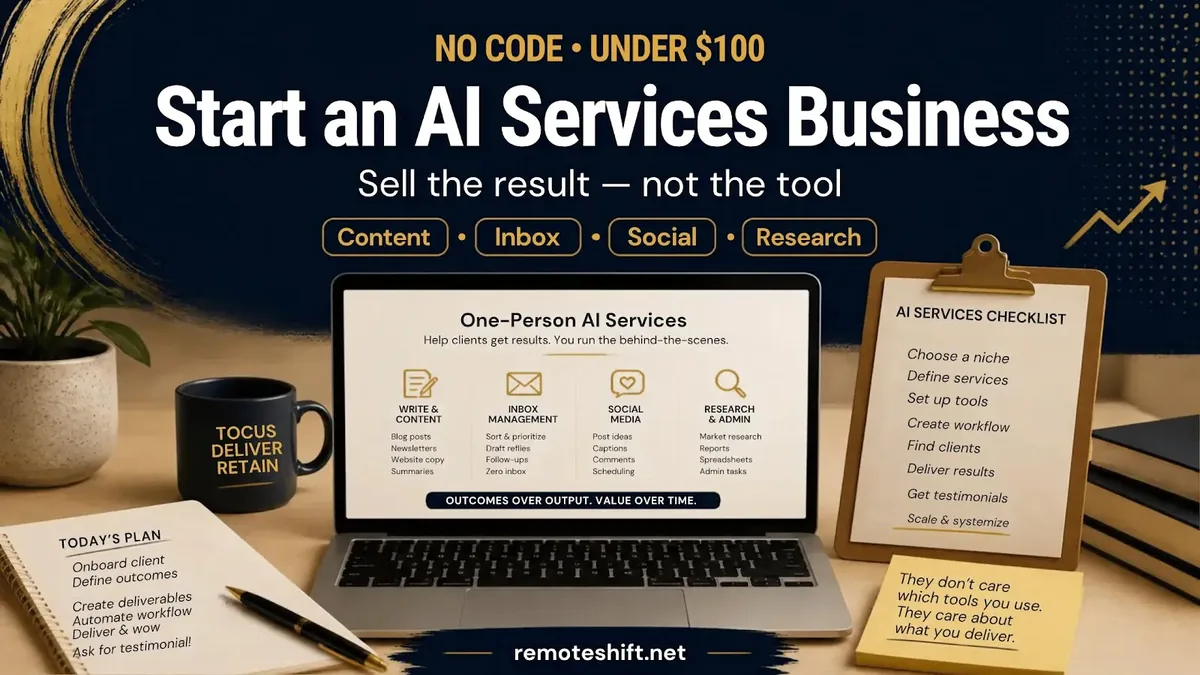
An AI services business is a one-person operation where you use AI tools like ChatGPT to deliver work businesses already pay for — writing, inbox management, social media content, research — faster than they could do it themselves. You don't need to code, have a website, or show your face. You need to be reliable, communicate clearly, and deliver what you promise. First clients are realistic within weeks. The key move is charging a flat monthly package rather than hourly, so every month you get faster (with AI's help) your effective rate climbs without changing the price.
Everyone is talking about making money with AI. Almost nobody explains what that looks like on a Tuesday afternoon when you have a regular job, a laptop, and zero coding skills.
Here's the boring, honest version. The boring version is the one that actually works.
What an AI services business actually is
An AI services business is a one-person operation where you use AI tools — primarily ChatGPT, but plenty of others — to deliver services that businesses already pay for: writing, customer email handling, social media content, research, admin work. You deliver the result faster and more cost-effectively than a business could do it themselves.
One sentence matters more than anything else in this guide: you sell the outcome, not the tool. Your client doesn't care whether AI was involved. They care that their fifty product descriptions were written, their customer emails got answered professionally, or their weekly newsletter went out on time. AI is your back office. The service is the product.
The job is to use AI as a skilled craftsperson uses a good power tool — not to replace your judgment, but to dramatically accelerate it. You add the human layer: the editing, the context, the judgment that raw AI output lacks and clients can immediately detect when it's missing.
Why this works for complete beginners
Most online business models punish beginners with a long ramp-up. YouTube takes months before anyone watches. Affiliate sites take six months to rank. A blog needs a year before it earns anything consistent.
An AI services business can produce its first invoice within weeks, because you're selling into demand that already exists — small businesses drowning in repetitive work. The demand is permanent. The competition is fragmented. And the barrier to entry is a free ChatGPT account, not a year of audience building.
You don't need to code. You don't need a website on day one. You don't need to show your face or have a following. You need to be reliable, communicate clearly, and deliver what you promised on time. If you've ever worked in customer service, admin, or any role where someone counted on you to handle things — you already have the hardest skills. The AI part is genuinely the easy part.
The honest catch: this is still a service business in the beginning. You trade time for money. The way out of that trap — and there is a real, clean way out — is covered below. The difference between building a business and building yourself another job comes down to one structural decision.
What AI services you can actually sell
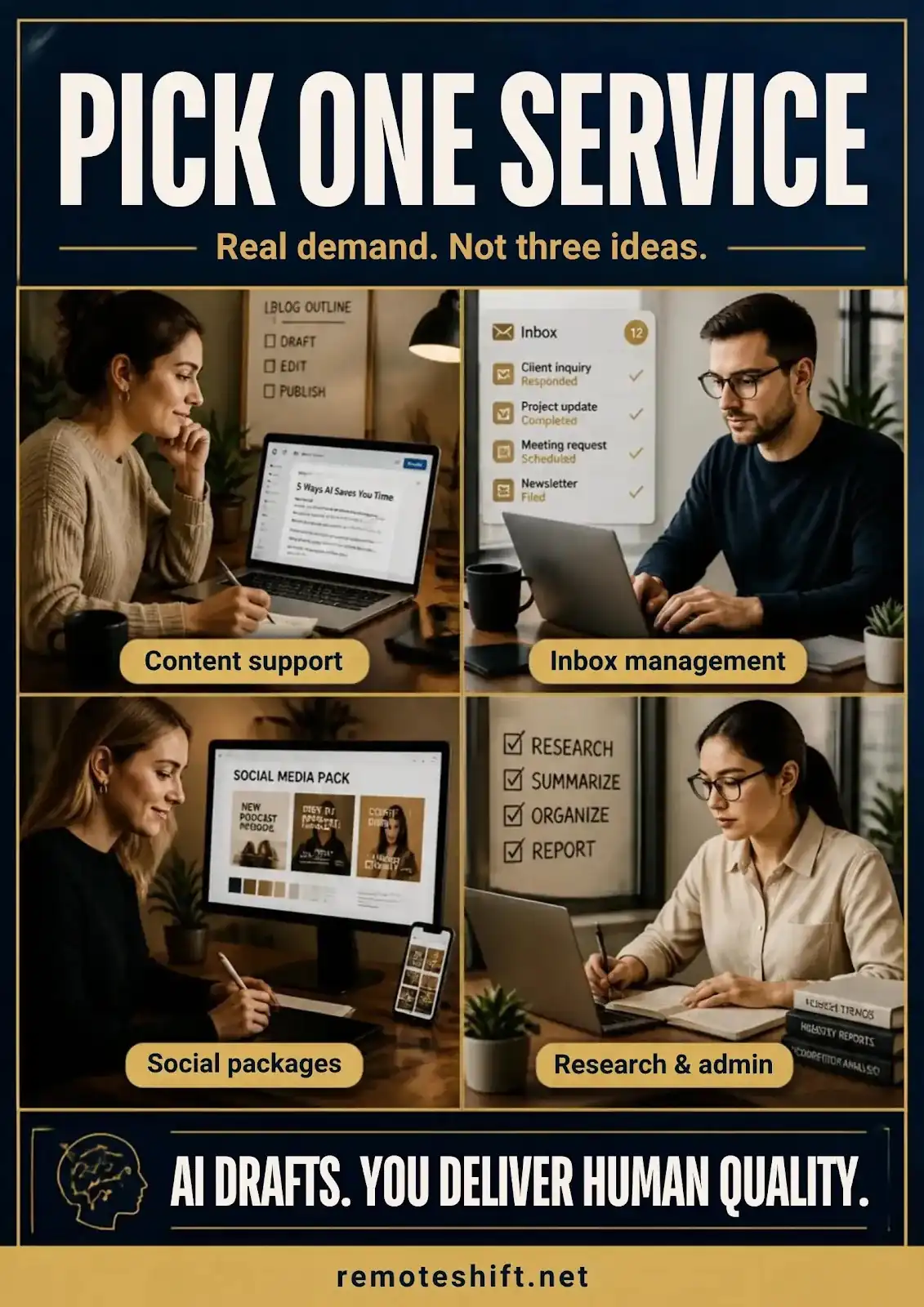
Pick one service to start. Not three. One. Here are the categories with real, paying demand right now.
Content support for small businesses. Blog posts, product descriptions, email newsletters, website copy. Small business owners know they need this and hate doing it. You use AI for the first draft, then edit it into something that sounds genuinely human — that editing step is your entire value, because raw AI writing is recognizable and clients know it when they see it. The edit is what you're selling.
Customer email and inbox management. If you've worked in a call center or support role, this is your specific advantage. Businesses pay for someone who can handle their support inbox with professional, friendly replies. AI drafts; you review and send. The years you spent knowing how to de-escalate an angry customer, read what someone really needs, and respond in a way that preserves the relationship — no tool replicates that. You do it fast, they see the results, they renew.
Social media content packages. A month of captions, post ideas, and short video scripts, delivered as one clean package. Completely faceless, highly repeatable, and naturally priced as a flat monthly fee that makes both sides happy.
Research and admin support. Competitor research, document summarizing, data organizing, report preparation. Unglamorous, steady, and businesses pay for this consistently every month because it never stops needing to be done.
What you need to start — honestly under $100
A laptop, an internet connection, a free ChatGPT account, and a free Canva account. That's the real list.
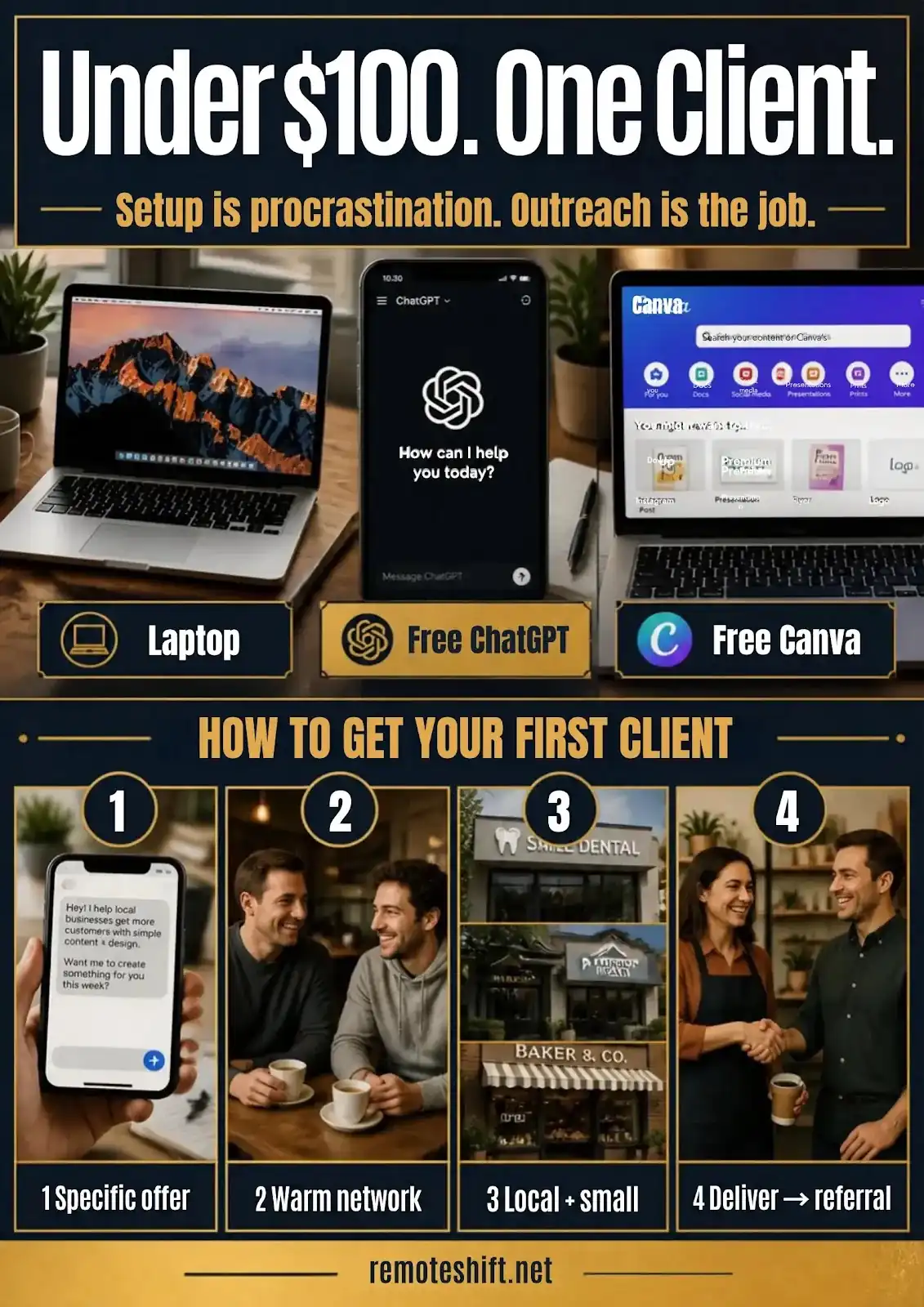
You do not need a paid AI subscription on day one. You do not need a logo, a registered company, a course, a portfolio website, or a business email. The most expensive mistake beginners make is spending two months "setting up" before finding a single client. Setup is procrastination wearing a business suit. The only thing setup produces is the feeling of progress without any actual progress.
The one legitimate early task: sorting out how you'll receive money. Especially if you live outside the US and your clients will pay in dollars — more on that below.
How to get your first client
Skip cold outreach to strangers for now. Start with warmth.
Write one clear sentence describing what you do: "I help small businesses handle their customer emails / write their weekly content / manage their social posts — for a flat monthly fee." Specific beats clever. Vague loses.
Send it to people who already know you exist — former colleagues, old clients, managers you've stayed in touch with. Don't pitch. Ask one question: "Do you know a business owner who's drowning in this?" Referrals convert better than any cold message you could send, because trust transfers.
Look local, look small. A dentist, a real estate agent, a small online store. They have the problem, they have a budget, and no agency is actively chasing them because the contract value is too small for agencies to bother. That's your window.
Price your first project low enough to win it cleanly, deliver it like your reputation depends on it (it does), and immediately ask for a testimonial and a referral. That loop — win, deliver, ask — repeated consistently is the entire growth strategy for your first six months.
The move most people miss: productize it
Here's where this stops being freelancing and starts being a business worth having.
Instead of charging by the hour or project, sell a fixed package at a fixed monthly price. "Customer inbox handled Monday to Friday — one flat fee." "Eight blog posts a month — one flat fee." The client knows exactly what they pay. You know exactly what you deliver. Nothing negotiated twice.
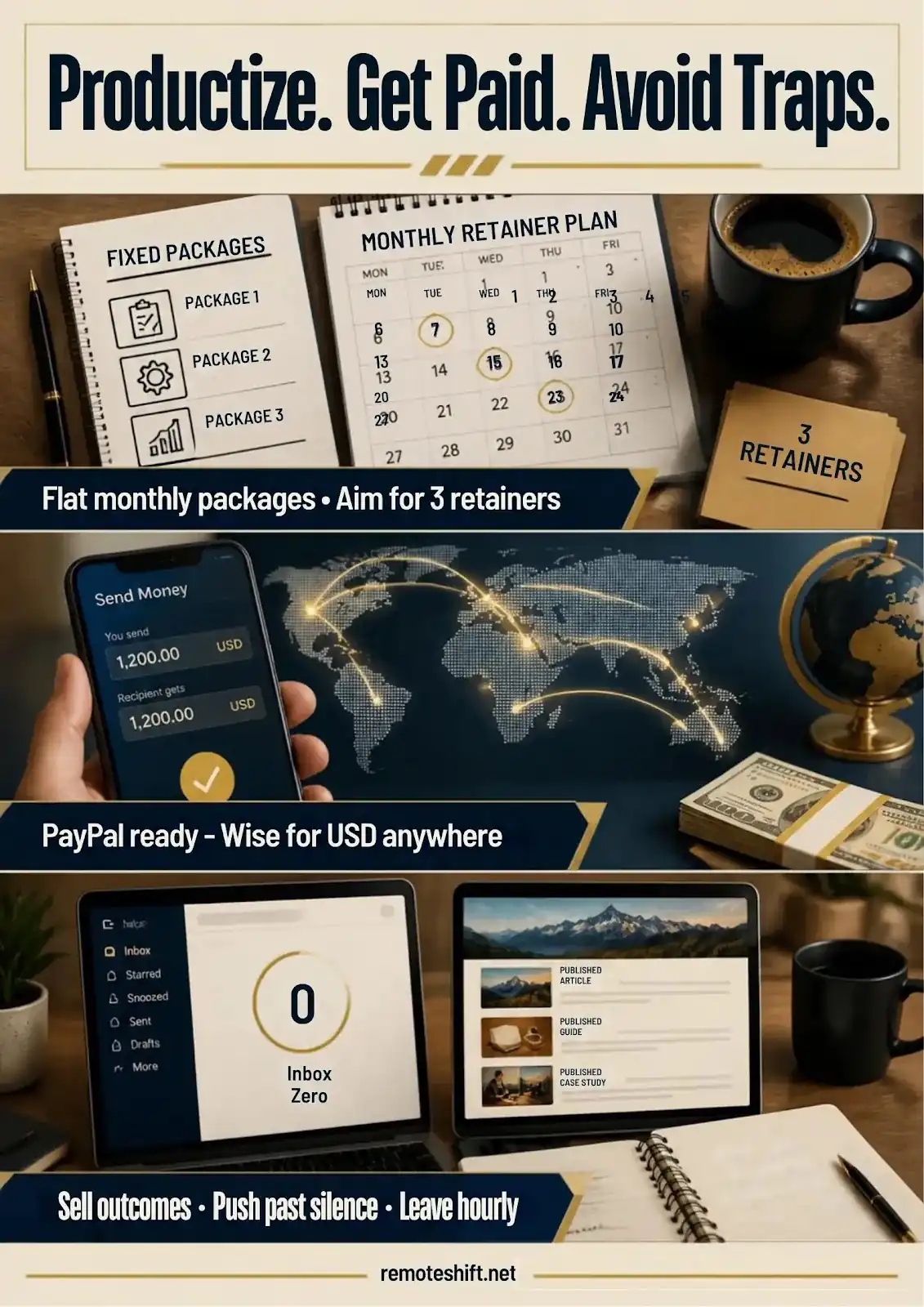
The AI leverage shows up here: because AI compresses the time each package takes, your effective hourly rate climbs every month as you get faster — without you ever raising prices on existing clients. You're building a productized service with an AI-powered back end, and the efficiency compounds over time. (For the full blueprint on building a productized service, that guide covers everything from pricing to scope to first clients.)
Three clients on monthly retainers is the first real milestone. Three clients at $400–700 each is genuine, recurring income — not a one-off project, a predictable number that's already there when the month starts.
How to get paid in USD from outside the US
If you're outside the US, payment handling can quietly eat your margins. Clients pay in dollars; banks and processors take their cut converting it.
PayPal works and most US clients trust it — have it set up and ready. For significantly better exchange rates and a real USD account number you can put directly on invoices, a Wise account is worth the fifteen minutes it takes to set up. It lets you receive dollars the way a US business would, then convert when the rate suits you. Disclosure: affiliate link — RemoteShift earns a small commission if you sign up through it, at no cost to you.
What most people get wrong
They sell "AI" instead of outcomes. Nobody wakes up wanting to buy AI. They wake up wanting their inbox under control and their content published on time. Lead with the problem you solve, not the tool you use to solve it.
They quit at the silence. The first ten outreach messages will mostly go unanswered. That's normal — it's the expected cost of entry for any new service. The people who push to message twenty find the clients. The people who stop at ten conclude it doesn't work. Same market, different persistence.
They stay hourly forever. Hourly feels safer and caps your income permanently. Productize as soon as you have one delivery you can repeat.
Is this right for you?
An AI services business rewards people who are organized, communicate well, and can be trusted to handle someone else's business with care. It frustrates people who want passive income from day one — this is active work in the beginning that becomes leveraged work over time, not money while you sleep.
Not sure where you fit compared to the other paths — remote work, affiliate marketing, newsletter, digital products, YouTube? Our free 60-second quiz matches your background against the options honestly, with real income expectations and ramp-up times, not hype. Take it at remoteshift.net.
FAQ
What is an AI services business?
A one-person service business where you use AI tools like ChatGPT to deliver work small businesses already need and pay for — writing, inbox management, social content, research. You sell the result, not the technology. Clients pay for outcomes, not for knowing how you produced them.
Can you start an AI services business with no coding skills?
Yes, completely. The AI tools that power most AI service businesses — ChatGPT, Canva AI, Notion AI — require no coding. The skills that matter are reliability, clear communication, ability to edit AI output to sound human, and delivering on time. Customer service and admin backgrounds transfer directly.
How do you get your first AI services client?
Start warm — tell former colleagues and employers what you're offering with one specific sentence. Ask if they know a business owner with the problem. Look at small local businesses: dentists, real estate agents, small online stores. Price your first client low enough to win easily, deliver excellently, ask for a testimonial and a referral.
How much can you earn from an AI services business?
With three monthly retainer clients at $400–700 each, you're at $1,200–2,100/month. Those numbers are achievable within 2–4 months for someone who works the outreach consistently. As AI tools speed up your delivery, your effective hourly rate climbs without needing to raise prices.
Do you need to buy AI tools to start?
No. Free tiers of ChatGPT and Canva cover everything you need to start. A paid ChatGPT subscription ($20/month) becomes worthwhile once you have a paying client — but it's not a prerequisite. Start free, upgrade when income justifies it.
Pay and price figures in this guide are typical ranges from public listings and platform pages, not guarantees. Your rate depends on your skills, country, client and platform.