 RemoteShift
Affiliate Marketing for Beginners: The Honest Guide
Affiliate marketing is real, it works, and it is nowhere near as fast or passive as the screenshots make it look. The actual model: you recommend products you trust, people buy through your link, you earn a commission. Real income typically takes 3–9 months to build. The five reasons most beginners fail are chasing big commissions over trusted products, spamming links, needing a big audience, expecting passive from day one, and quitting in the quiet months. This guide covers the real steps, the real timeline, and the channels that work with no money and no camera.
I'll start with the thing nobody selling a course wants to say out loud: affiliate marketing is real, it works, and it is nowhere near as fast or as passive as the screenshots make it look.
You've seen the screenshots. Someone lounging on a beach, a phone showing a $14,000 commission notification, a caption about "building wealth while you sleep." That isn't entirely fake — affiliate income can add up to numbers like that. But the version being sold skips the boring eighteen months that came before the screenshot. The gap between the promise and the reality is exactly why most beginners quit before they earn a single dollar.
I run RemoteShift to help people figure out which online income path actually fits them. I also earn affiliate commissions myself — when someone I send to a language-tutoring platform like italki signs up, I earn a small cut at no extra cost to them. So this isn't theory. It's the inside view, with the unglamorous details still attached.
What affiliate marketing actually is, in plain language
Strip away the jargon and it's simple. A company sells something. You recommend that something to other people. When one of those people buys because of your recommendation, the company pays you a percentage. That's your commission.
You're not buying inventory. You're not handling customer support. You're not shipping anything. Your job is to be the trusted person in the middle — the one who says "hey, this thing solved my problem, here's how it works" — in front of enough of the right people that some of them act on it.
The link you share is a special tracking link the company gives you. It quietly tells them "this customer came from me" so you get credited. That's the entire mechanism. Everything else is just the work of getting good recommendations in front of people who trust you.
The honest truth about the money
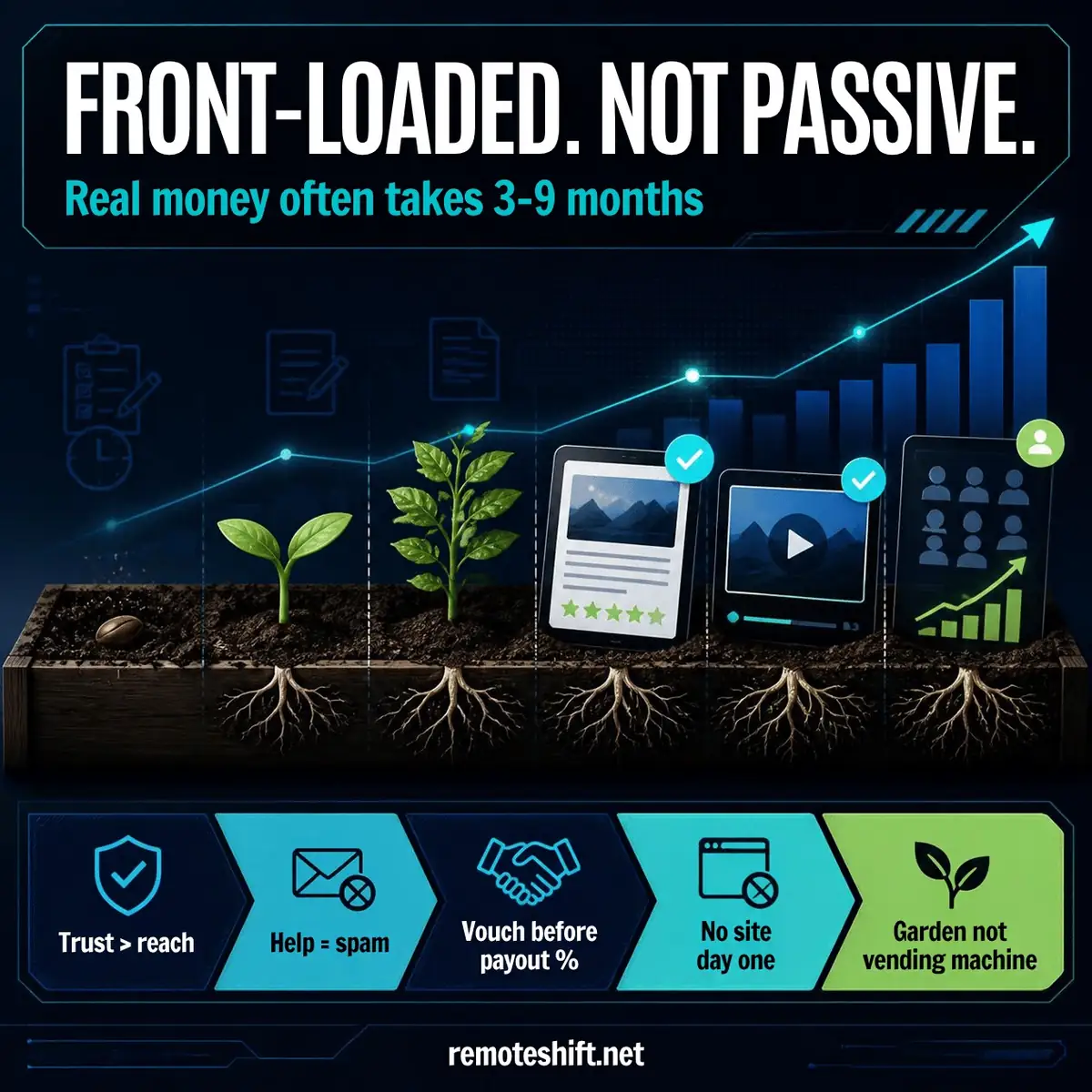
Affiliate marketing is not passive income. Not at the start. It becomes partly passive later, after you've built something that keeps working without you — a blog post that ranks on Google, a video that keeps getting found, an email list that keeps growing. Those assets can earn while you sleep. But you have to build them first, and building them takes months of work that pays you nothing while you're doing it.
The honest word is front-loaded. You do a lot of unpaid work up front, and if you do it well, it pays you for a long time afterward. That's a genuinely good deal — it's just not the deal that gets sold.
The second hard truth: your first real dollar takes longer than you want. For most beginners doing this honestly, consistent income — not a fluke five dollars, but money you can count on — shows up somewhere between three and nine months in. Some get there faster. Plenty take longer. Anyone promising fast is either lying or selling you a shortcut that doesn't exist.
Month two is not failure. Month two is the middle of the part everyone hides.
The five lies that keep beginners broke
You need a huge audience. You don't. You need a trusted one. A hundred people who believe you will out-earn ten thousand who scrolled past. Trust converts. Reach without trust is noise.
More links, more money. Spamming your affiliate link into comment sections and group chats does the opposite. It kills trust, gets you banned, and converts almost nobody. The money is in genuine recommendation, not volume.
Pick the product with the biggest commission. This is backwards and the most common mistake. Beginners chase the 40% payout on a product they've never used and wouldn't recommend to a friend. Nobody buys, because the recommendation feels hollow — because it is. Pick what you'd actually vouch for first. Commission comes second.
You need a website on day one. You don't. You can start on platforms you already use and understand. A website comes later, if at all.
It's a money machine you set and forget. It's a garden, not a vending machine. You plant, you wait, you tend it. Things grow on their own timeline, not yours.
How to actually start — the real steps
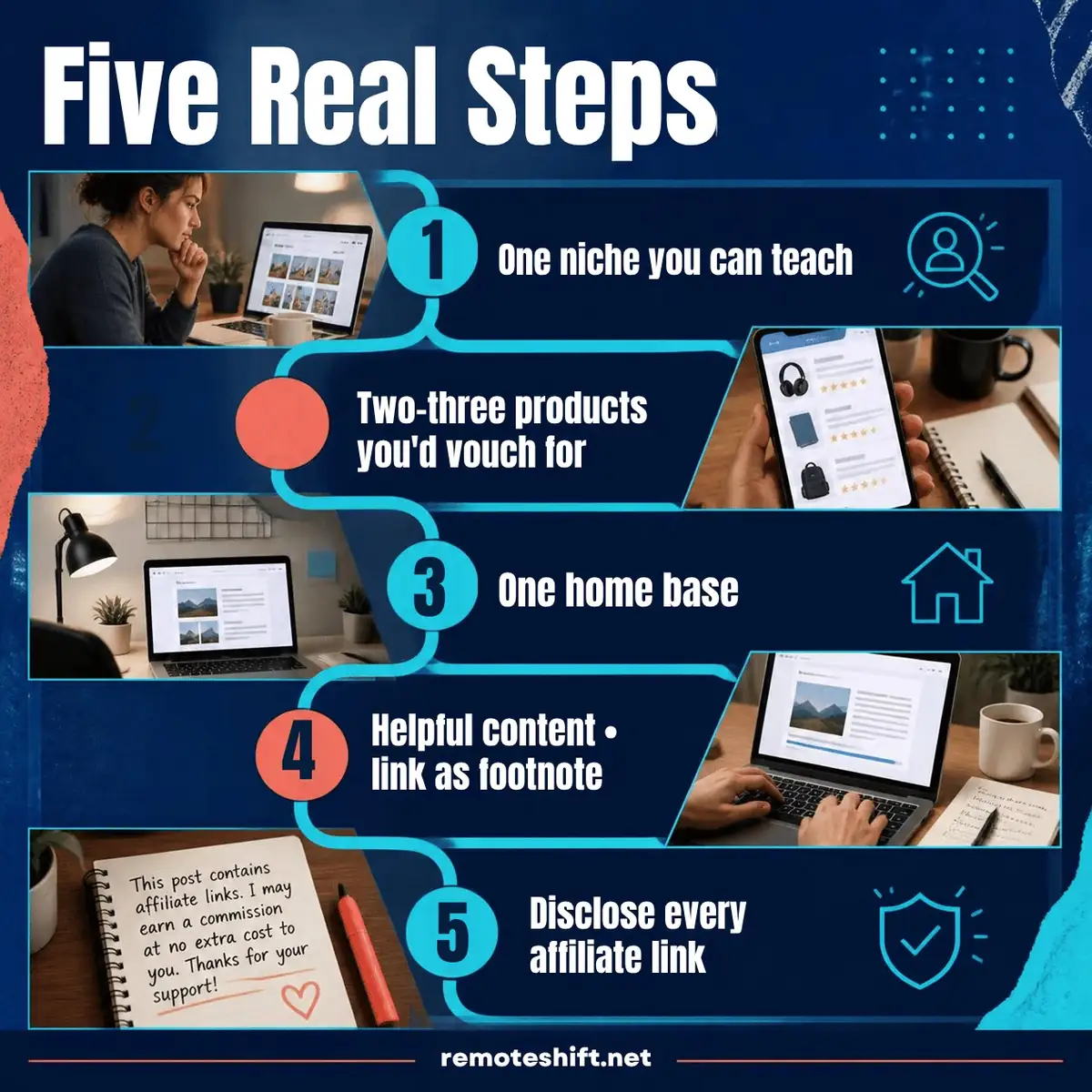
Step 1: Pick one niche you actually know or care about. Not "the most profitable niche." One you can talk about honestly without running dry in a week. Remote work, language learning, budgeting, a hobby you've done for years. The test: could you help a confused beginner in this area? If yes, that's a niche. Pick one and commit. Spreading across five topics is how beginners stay invisible.
Step 2: Find two or three products you'd genuinely recommend. Ideally things you've used. Go to a company you already trust in your niche and scroll to the very bottom of their website — look for a link that says "Affiliates," "Partners," or "Referral program." Most decent companies have one, and most are free to join. Sign up, get your tracking link, and you're ready. Don't join twenty programs. Two or three you actually believe in is plenty to start.
Step 3: Pick one home base where your recommendations will live. This is your blog, your Pinterest profile, your YouTube channel, or your newsletter. You only need one to start. More on the right channel below.
Step 4: Make genuinely useful content. Not ads. Not "buy this." Content that helps someone make a decision or solve a problem, and naturally mentions the product you recommend along the way. A comparison guide. An honest review that includes the downsides. "Here's how I'd start learning Spanish on a budget," with your tutoring-platform link woven in where it belongs. Help first. The link is a footnote to the help, never the point of it.
Step 5: Disclose your links, always. When you share an affiliate link, you have to tell people it's an affiliate link. In most countries this is legally required, and beyond the law, it builds the trust that makes the whole thing work. One honest line — "some links in this post are affiliate links, which means I earn a small commission at no extra cost to you" — covers you. People respect the transparency. It makes them more likely to use your link, not less.
Channels that work with no money and no camera
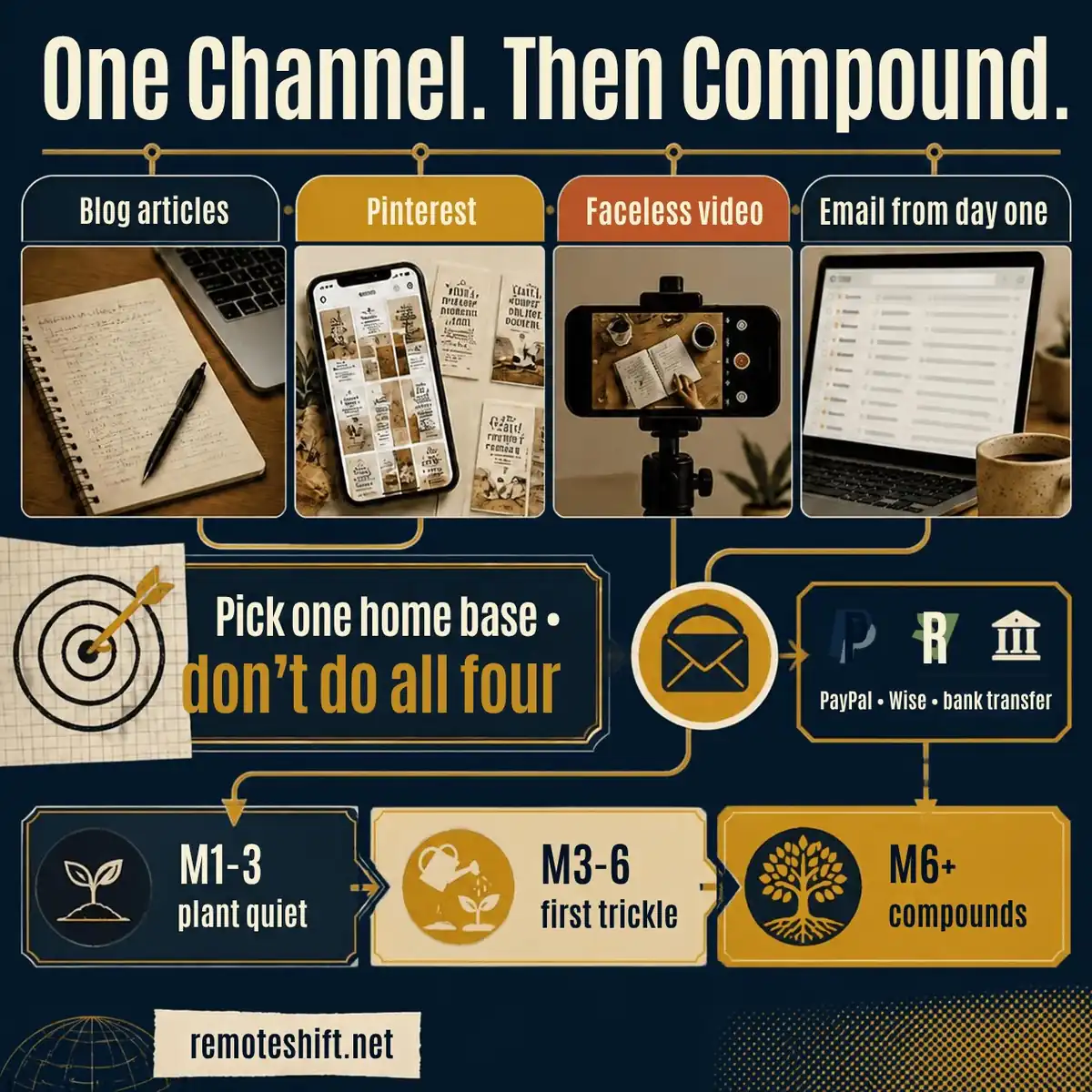
A blog or written guides. The most durable channel there is. A well-written guide that ranks on Google can send you free visitors for years. It's slow to start and rewards patience, but nothing else compounds quite like it. If you can write, start here.
Pinterest. Massively underrated for affiliates, and completely faceless. You make simple graphics that link to your content, people save and click, and good pins keep working for months. Low effort per pin, no camera required, no talking.
Faceless short video — YouTube Shorts, TikTok, Reels. If writing isn't your strength, short faceless videos are the other real path. Voiceover over stock footage, screen recordings, simple text on screen. A different skill set, but a legitimate channel with real reach. Our guide to building a faceless social media page walks through the full setup.
An email list. Not a starting channel on its own, but something you should be building from day one regardless of what else you do. Every visitor you get from the channels above, you want to invite onto an email list — because an email list is the one audience a platform can't take away from you. It's the most valuable asset in this whole game. Here's how to start a niche newsletter from zero.
For a true beginner: pick one of the first three as your home base, and start collecting emails from the beginning. Don't do all four at once. You'll burn out and quit, which is the only real way to fail at this.
How you get paid
When you cross a program's minimum payout (usually $10–50), they pay you — typically monthly. Most reputable programs pay by bank transfer, PayPal, or a service like Wise. PayPal works for a huge share of programs worldwide and is the simplest starting setup. Link it where the program asks and commissions land there on their schedule.
The real timeline
Months 1–3 are usually the hardest, because you're building and getting almost nothing back. This is the stretch where almost everybody quits — which is also exactly why almost everybody fails. The ones who make it are simply the ones who kept planting through the quiet months.
Somewhere around month 3–6, if you've been consistent, you see the first real trickle. A commission here, another there. Small, but it's proof the machine works.
From month 6 onward, the assets you built start compounding. The blog post that finally ranks. The video that finally gets found. The email list that's finally big enough to matter. This is where affiliate income can start replacing real income — not because you got lucky, but because you front-loaded the work and now it's paying you back.
Patience now for freedom later. If you're the kind of person who can keep showing up when nothing's happening yet, affiliate marketing will reward you more than almost any other model out there.
Not sure if affiliate marketing is the right starting point for you? Our free 60-second quiz takes your background and tells you which online income path fits your skills and situation best. Take it at remoteshift.net.
Disclosure: the italki and Wise links in this article are affiliate links. If you sign up through them, RemoteShift may earn a commission at no extra cost to you.
FAQ
How does affiliate marketing work for beginners?
You join a company's affiliate program (free), get a unique tracking link, and share that link in content you create — a blog post, a video, a social post. When someone clicks your link and buys the product, you earn a commission. The company tracks this through your link automatically. No inventory, no customer support, no shipping required on your end.
How long does it take to make money with affiliate marketing?
For most honest beginners who are consistent, the first real income (not a one-off fluke) arrives between 3 and 9 months in. People who quit in the first 2–3 months almost always leave right before it starts working. Anyone promising money in weeks is selling a shortcut that doesn't exist.
Do I need a website to start affiliate marketing?
No — a website helps long-term but isn't required on day one. You can start with a Pinterest profile, a YouTube channel, or even a newsletter. The website becomes more important as your content grows and you want a home base you own and control, but beginners can earn commissions without one.
Which affiliate programs are best for beginners?
Programs tied to products you actually use and trust are best, regardless of commission size. Programs with low payout thresholds, reliable payment methods, and long cookie windows (30–90 days) are easiest to start with. Avoid programs that are hard to get approved for until you have some track record.
How much can you realistically earn from affiliate marketing?
It varies enormously by niche, effort, and how long you've been building. A realistic range for someone who's been consistent for 12 months is $200–2,000/month USD. Some niches and creators earn far more — but those are typically people 2–5 years in, not months.
Pay and price figures in this guide are typical ranges from public listings and platform pages, not guarantees. Your rate depends on your skills, country, client and platform.